

When the temperature outside starts climbing, and you curse the fact you didn’t invest in an air con unit, it’s not just your workshop that feels the heat.
Your air compressor might be struggling too.
Particularly if you have an industrial screw compressor working hard throughout the day.
So, what happens when a compressor gets too hot? And what should you do if yours suddenly shuts down?
Our compressor expert Gary explains what to look out for, what you can check yourself and one thing you definitely shouldn’t do if your compressor starts overheating.
Why Do Air Compressors Overheat in Hot Weather?
First, your compressor getting hot isn’t unusual.
Heat is a natural by-product of compressing air, so every time your compressor is running, it’s also producing heat that needs somewhere to go.
Most of the time, that’s all taken care of. But throw in a heatwave, a compressor working hard all day and a workshop that’s already doing a passable impression of a sauna, and things can start getting a little toasty.
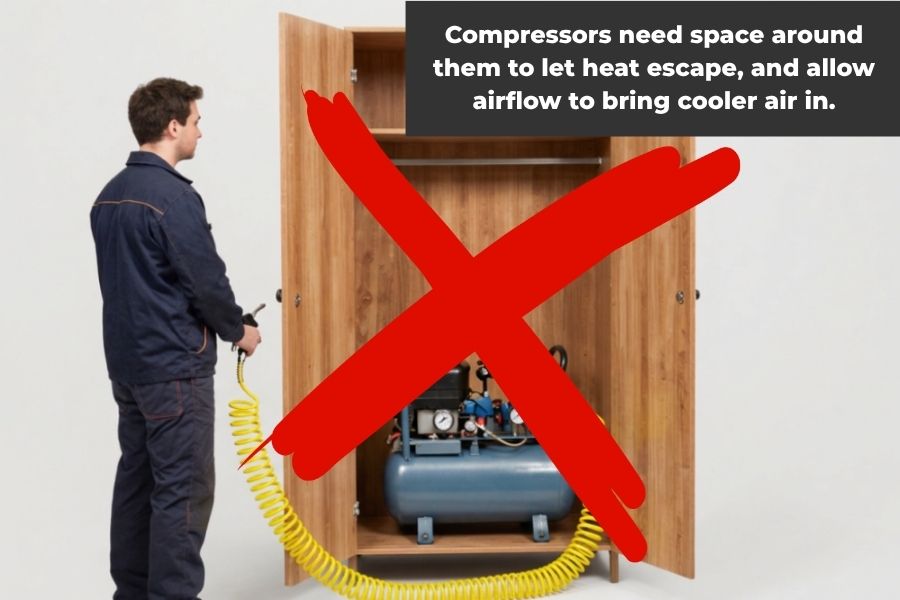
The location of your compressor matters too.
A screw compressor will usually expel hot air from the top of its cabinet. It needs enough space around it for that heat to escape and plenty of airflow to bring cooler air in.
If it’s tucked into a cramped area or cupboard with poor ventilation, that hot air has nowhere useful to go.
And your compressor definitely doesn’t want it back.
What Happens If a Screw Compressor Gets Too Hot?
The good news is that your compressor knows it’s getting hot.
Modern screw compressors have sensors that monitor the temperature inside the machine. If things get too hot, the compressor will shut itself down to help protect its components.
You’ll usually get an error code on the controller at the same time.
Make a note of it.
Don’t immediately clear the code, hit reset and tell the compressor to get back to work. That error code is there for a reason and could help an engineer work out exactly what’s going on.
Speaking of things you shouldn’t do…
Whatever You Do, DON’T Take the Panels Off
We can understand the thinking here.
Compressor hot. Remove panels. More cool air gets in. Problem solved.
Right?
That’s a big fat NOPE.
This is one of those occasions where doing something that feels completely logical can actually make the situation worse.
The cabinet of a screw compressor isn’t just there to keep all the important-looking bits hidden away.
It’s designed to control the airflow through the machine, drawing cooler air inside and directing it around the motor, air end (screw) and electronics before expelling the hot air.
Take the cabinet panels off and you disrupt that carefully designed airflow.
So, as Gary puts it:
“One thing you MUST NOT do is run the compressor with the cabinet panels removed thinking it will help cool it down. It won’t.”
Your compressor does not need to strip off for the summer!
Leave the panels on.
Help! My Air Compressor Has Shut Down
First things first: don’t keep resetting it.
If your compressor has shut itself down because it’s too hot, repeatedly switching it back on is a bit like ignoring the temperature warning light on your car and carrying on up the M25.
Instead, start with a couple of simple checks.
Firstly, have a look at the oil level. Too little oil can cause problems, so make sure there’s enough in accordance with the requirements for your particular compressor.
If the oil level is fine, make a note of that error code we mentioned earlier.
Secondly, look around the compressor itself.
Has it got enough breathing room? Can air circulate around it? Is there enough space above it for the hot air to escape?
If nothing obvious jumps out, it’s probably time to give us a call.
Before You Call Us, Do a Little Compressor Detective Work
Don’t worry, we’re not expecting fingerprints and a magnifying glass.
But there are a few things you can find before calling that will help our engineers get a much better idea of what might be happening.
If you’re already a Metro Sales customer, we’ve got a head start. We should be able to check our records and see which compressor you have, along with information such as when we last serviced it.
If we’ve never met your compressor before, try to have these details handy:
- Make and model
- Serial number
- Error code on the controller
- When it was last serviced, if you know
- A photo showing where the compressor is installed
The error code is particularly useful because different compressor manufacturers use different codes.
And yes, we really do want to see a photo of your compressor.
We’re not judging the state of your workshop.
It lets our engineers see where the machine is installed, how much space it has around it and whether ventilation could be contributing to the problem.
The more information we have, the easier it is to work out the best next step and whether an engineer needs to visit and fix your air compressor.
Your Compressor Produces Heat… Could You Actually Use It?
Here’s something you might not have considered.
All that heat being pushed out of your compressor doesn’t necessarily have to disappear into thin air.
In some industrial environments, the heat produced by a compressed air system can be captured and reused through a heat recovery system.
Clever, eh?
Now, we’re going to hold our hands up here. Regenerative heat recovery is a specialist field and we’re not going to suddenly declare ourselves experts in it for the sake of a blog.
But we do know people who know considerably more about it than we do.
So, if you’re interested in whether the heat produced by your compressed air system could be put to better use, get in touch and we’ll help you find the right advice.
Can You Stop an Air Compressor Overheating During a Heatwave?
We’d love to tell you Metro Sales has developed revolutionary technology that controls the British weather.
Sadly, Gary hasn’t quite cracked that one yet.
What you can control is the environment around your compressor.
Give it plenty of space and airflow, make sure the hot air it produces has somewhere to escape and keep an eye on the oil level.
Regular servicing matters too. A compressor that’s already having to work harder than it should isn’t going to thank you when the temperature outside starts nudging 30°C.
And we know we’ve said it already, but apparently people really do this…
Don’t take the panels off.
Air Compressor Overheating? Give Us a Call
If your air compressor is overheating, displaying error codes or repeatedly shutting itself down, don’t spend the rest of the afternoon playing a game of reset-and-hope.
Make a note of the error code and give us a call: 01932 348777
If you’re new to Metro Sales, grab the make, model and serial number and take a quick photo of where the compressor is installed too.
We’ll talk through what’s happening, look at the information you’ve provided and help work out the best way forward.
Then you can get back to the important business of complaining about how ridiculously hot it is… but with a healthy air compressor at least!
If there’s no hope for your compressor and it’s come to the end of its life, you can shop our fantastic range of air compressors online!
